Humility before titles.Understanding before trust.
A candidate arrives with trust, but without a map of the system. Start with the right to understand: who decides, who holds them accountable and what each payment actually covers.
First steps: knowledge, character and fraternal love
The Apprentice’s path begins with a willingness to learn, examine oneself and put learning into practice. Titles, ritual and regalia cannot replace personal effort, honesty or consideration for others.
Lodge, Grand Lodge, Supreme Council, warrant, recognition, degree. Familiar words to an insider may convey only an impression of importance to a candidate. There is no shame in not knowing. Those welcoming new members have a responsibility to explain without pressure or intimidation.
Imagine a candidate who first encounters ceremony, hospitality and impressive titles. Only later do they ask who elects the leadership, where the minutes are and how to appeal. If explanations keep giving way to promises, understanding the structure may take months — even a year or more. This is a possible scenario, not a research-based timeframe or a claim that every candidate is deceived.
If promises prove inconsistent with reality, invested time, money and a sense of belonging can make departure harder. Ask important questions before initiation. A dignified fraternity gives you room to ask, reflect and freely say no.
THE INITIATIVE’S AFFORDABILITY PROPOSAL
Dues are not the price of light.
≤ 50 €Entry · proposed ceiling
100–150 €Annual dues · proposed range
We advocate an entry fee of no more than €50 and annual dues of €100–150. This is our proposal for an affordable model, not a universal rule, an established international tariff or a test of regularity. Costs vary between lodges and countries; a higher fee alone does not establish fraud.
Before paying, request the full annual cost: admission, dues, dining, regalia, travel and any degree fees. Ask for the purpose, recipient and receipt in writing. Do not accept promises of influence or spiritual worth in exchange for money.
Our editorial position: public communication should be measured, educational and verifiable. A TikTok or Instagram account alone proves neither quality nor fraud. Examine the promises and how candidates are treated. Masonic secrets should be preserved within lodges. Under our editorial principles, disclosing another member’s identity or Masonic affiliation without their explicit consent is prohibited. Discretion protects members; it must not be used to conceal abuses.
An offer of online initiation, an instant degree or a patent in return for payment: pause and independently check the procedure and authority.
Repeated calls, pressure to decide immediately or payment before access to rules: request time and documents.
Leader self-promotion, promises of power, business or the “only true path” in place of clear rules: seek verifiable information.
Discouraging questions, independent checks or conversations with former members: resist isolation.
An online enquiry or introductory conversation is different from online initiation. UGLE and GODF publicly explain how to express interest; an invitation or informative contact alone is not evidence of abuse.
Large groups and hidden phone numbers can serve practical or privacy purposes. The warning sign is their combination with anonymous leadership, unverifiable claims and no accountability.
Hundreds of accounts do not prove hundreds of initiated, active or dues-paying members. Ask what the figure measures without demanding disclosure of members’ personal data.
Impressive offices absent from the constitution or rules, without elections, terms or defined powers: request their documentary basis.
“We are registered, therefore everything is regular” does not answer questions about Masonic recognition, patent provenance, financial oversight or members’ rights.
Cash collection or transfers to personal accounts without an identified recipient, receipt, purpose and accounting: pause payment until clarified.
An unavailable annual financial report or record of its adoption by the competent body: request the report, minutes and rule identifying who reviews it — the assembly where the statutes provide for this.
These are grounds for scrutiny, not automatic evidence of a crime. Members’ privacy can coexist with accountable leadership and clear aggregate financial reporting.
01 / LANDMARKS
Ancient landmarks: 25 principles
A concise rendering of all 25 of Mackey’s nineteenth-century propositions, without his extended commentary. This is not a single constitution for worldwide Freemasonry. Acceptance and interpretation differ between obediences.
XII
Representation
Members’ representation at general meetings and instructions to their representatives.
XIII
Appeal
Recourse to a higher Masonic body following a lodge decision.
A document starts an inquiry; it does not verify every claim it contains. Originals retain their supplied language; descriptions and analysis are available in three languages.
SR · PDF · 32 pages
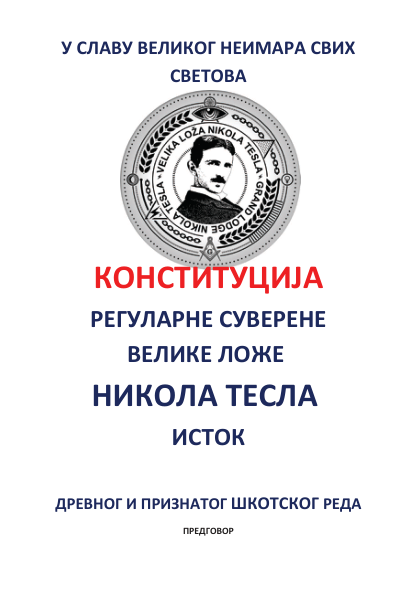
“Nikola Tesla Istok” constitution
Supplied copy
Organisational text on the assembly, terms, tribunals and appeals. The last page states adoption on 02.10.6019 and promulgation on 09.10.6019. Current validity has not been independently verified.
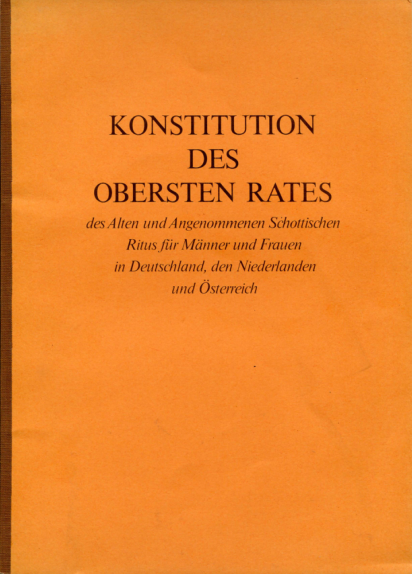
Text of the Scottish Rite Supreme Council for men and women in Germany, the Netherlands and Austria. Neither a 1762 document nor a universal constitution of all Supreme Councils.
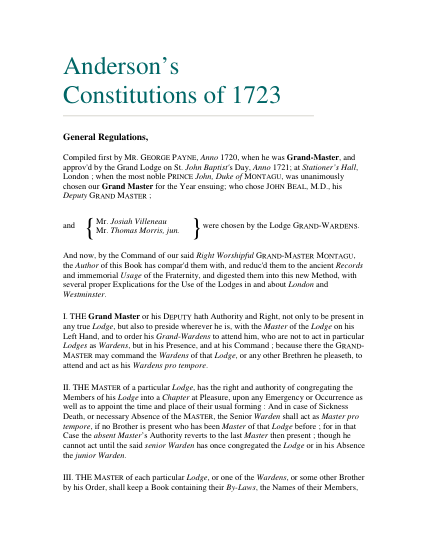
A digitised historical edition. Documentary provenance and traditional dating must be distinguished; historical context is linked through Scottish Rite SJ.
An initial reading of the supplied “Nikola Tesla Istok” constitution. We distinguish the rules, editorial interpretation and evidence of their implementation.
Humility is a virtue. A question is not disobedience.
Editorial principle of the initiative
04 / CAVE ANTE INITIUM
Before initiation, ask questions.
Tick only what you can support with a verifiable document. This checklist prepares a conversation; its score certifies neither regularity nor safety. Selections stay in this browser.
0 / 10 documented
Craft lodge · 1–3
Higher degrees · 4–33
Craft lodges and higher degrees
For degrees 1–3 and 4–33, check the jurisdiction of the specific obedience and its bodies. A rite’s name or possession of the 33rd degree does not by itself establish governing authority over all lodges. Relationships between Grand Lodges and Supreme Councils vary by jurisdiction.
Separate jurisdictions. Regalia appropriate to the meeting.
Our editorial position: governance of Craft lodges should not be confused with governance of higher degrees. A higher degree does not authorise someone to take control of another Masonic body.
Craft Freemasonry · 1–3
In a model of separate jurisdictions, symbolic lodges fall under their Grand Lodge and its constitutional organs. “Grand Council” may name a particular organ; it is not a universal name for the government of every obedience.
Scottish Rite higher degrees · 4–33
The competent Supreme Council governs its higher-degree bodies under its own constitution. Degrees 4–32 and the 33rd degree are distinct: the latter’s role and the council’s composition have specific rules. Not all these bodies are lodges, and “Red Masonry” does not universally denote the entire range.
Regalia do not transfer jurisdiction
Wear regalia permitted by the host body and the degree in which it is working. Unauthorised regalia belonging to another body should not be worn.
A Grand Commander has no automatic right to wear 33rd-degree regalia at a Craft lodge meeting or to govern that lodge by virtue of that office.
A Grand Master has no automatic right to wear the regalia of that office in bodies working degrees 4–33 or to assume their powers. Official visits require a separate check of the applicable protocol.
ORIGO · DOCUMENTA · VERIFICATIO
Verify provenance. A seal does not establish authority.
AI and document-editing tools make convincing alterations to text, signatures and seals easier. A photograph of a warrant or ceremonial certificate is therefore insufficient to authenticate it. The possibility of alteration does not itself prove that a particular document is forged.
Check the chain of foundation and authorisation
Request the full lodge and obedience names, warrant number and date, issuer, and the authority behind the foundation or consecration. “Masonic genealogy” here means a documented institutional lineage, not biological ancestry.
Seek confirmation from the named issuer through independently located official contact details, observing its correspondence protocol. Check authenticity, scope of authority and current status. A scan supplied solely by the claimant is not independent confirmation.
Distinguish foundation/consecration, current affiliation and recognition by another organisation. None automatically establishes the others. Ask who recognises whom, since when, and whether that recognition remains in force.
For membership and lodge counts, request the reporting date, definition of active membership, an active-lodge directory or a verified aggregate report. Followers, chat participants and historical totals are not active membership. Private member identities need not be published.
Basic orientation in Craft Freemasonry
Lodge — the local community
Grand Lodge / Grand Orient — the governing obedience
Association of Grand Lodges — optional cooperation, not a compulsory tier or universal superior authority
Verification is not always immediate: registers may be incomplete and official replies take time. No reply does not prove forgery. UGLE’s list records UGLE’s recognition, not universal recognition; its official correspondence protocol applies.
In many countries, several Masonic obediences operate alongside one another. Their existence establishes neither fraud nor mutual recognition. Ask what “regular” means: under which rules and recognised by whom?
These are examples, not exhaustive registers or membership recommendations. Traditions have different membership and recognition criteria. Check your specific lodge and the claims being made to you.
A lodge is a local body; an obedience brings lodges together; an international association connects obediences. A rite is a system of ritual work. These terms are not interchangeable.
Men’s, women’s and mixed lodges
LE DROIT HUMAIN is an international mixed order. OWF and HFAF are women’s Grand Lodges. GLMF is an example of a mixed obedience in France. Membership composition alone establishes neither honesty, recognition nor quality.
CLIPSAS brings together sovereign obediences while respecting different beliefs and rites. The Council for Freemasonry offers another model of cooperation among British Grand Lodges. Association membership does not imply universal recognition.
GODF lists the French Rite, Ancient and Accepted Scottish Rite, Rectified Scottish Rite and Memphis-Misraïm. GLDF works the Ancient and Accepted Scottish Rite. Check the rite and rules of the specific lodge.
Gran Loggia d’Italia degli ALAM and Grande Oriente d’Italia maintain separate organizations and official websites. Listing them here is not a ruling on mutual recognition.
 ORDO AB CHAO